Way Back When: Sunny Isles Beach's Motel Row, with camels, Bedouins and a horse and buggy
Before the condo towers, the oceanfront strip on Collins Avenue was lined with themed motels, giant signs and life-size statues.
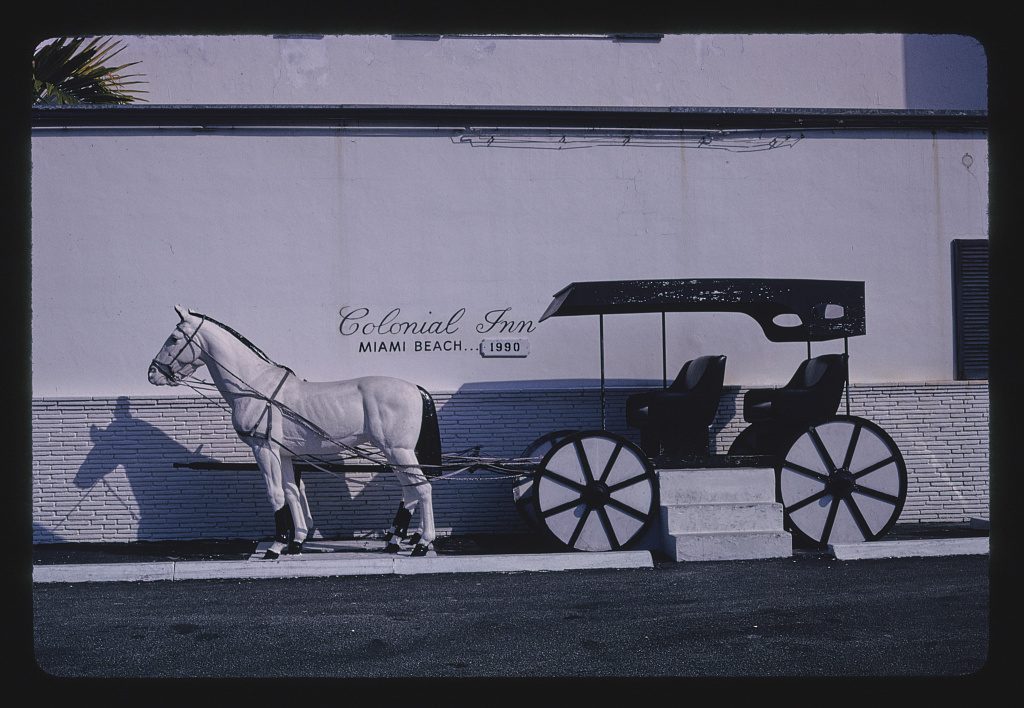
The horse and buggy above stood outside the Colonial Inn on A1A in Sunny Isles when photographer John Margolies came through in 1990. The Library of Congress, which holds his Roadside America archive, lists the picture as a “Colonial Motel statue.” It’s a snapshot of what the strip was known for: Motel Row.
The land deal came first. According to a history in the city’s Art in Public Places plan, Harvey Baker Graves (1855–1936) first visited South Florida in 1905 and came back in 1920 to buy 2,841 acres, including 1,912 acres at the northern end known as Sunny Isles.
Real development as a tourist destination came in the 1950s and 1960s, the same city history says, when motels such as the Dunes, Golden Strand, Thunderbird, Tahiti, Castaways, Ocean Palm and Sahara went up along the ocean. They came with life-size statues of Bedouins and camels, horses and buggies, and oversized lighted signs that the city’s history says turned night into day. Architects Carlos Schoeppl, Melvin Grossman and Norman Giller designed some of them. The oceanfront strip, with its Newport Fishing Pier, became known as Motel Row.
The motels didn’t last. Miami-Dade County created the City of Sunny Isles Beach by ordinance on Feb. 4, 1997, and voters approved its charter on June 16 of that year, according to the city. The city’s annual financial report says most of the tax-base growth after incorporation came from replacing old motels with luxury high-rise condominiums.
Today the city covers 1.78 square miles, according to its website. Its art plan now credits architects such as Carlos Ott, Kobi Karp and Sieger Suárez with the skyline that replaced the motels.
Sources
- Library of Congress — Colonial Motel statue, Sunny Isles, A-1A, North Miami Beach, Florida (John Margolies, 1990)
- City of Sunny Isles Beach — Art in Public Places Program (history section)
- City of Sunny Isles Beach — About Sunny Isles Beach
- City of Sunny Isles Beach — Municipal Charter
- City of Sunny Isles Beach — Annual Comprehensive Financial Report, FY2023 (local economy section)
See something wrong? Tell us.
Neighbors' comments
Comments are for people who live in Miami Beach, Surfside, Bal Harbour, Bay Harbor Islands, North Bay Village or Sunny Isles Beach. Keep it civil and on topic; the editor reviews first comments.